 电话
: 4000-697-999
 邮件
: jiechi@jiechi.com
电话
: 4000-697-999邮件
: jiechi@jiechi.com


Hospital floor cleaning sits in an awkward place. The floor has to look right for visitors, hold up to infection control scrutiny, and be cleaned in windows that keep shrinking as bed occupancy rises.
The building also contains more than one kind of floor, and the mistake most facilities make is running one method across all of them. What follows is a working framework: how to tier the zones, what noise actually costs you, how to verify results, and which machine fits which part of the estate.
Start by mapping the estate into tiers. Everything downstream, frequency, method, equipment, documentation, follows from that map.
Tier 1, critical. Operating theatres, ICU, isolation rooms, sterile processing, oncology day units. Highest consequence, smallest floor area, most documentation. Floors here are cleaned between cases and terminally at the end of a list, usually with dedicated equipment that never leaves the zone.
Tier 2, clinical. Wards, emergency department, imaging, dialysis, physiotherapy. Mixed traffic, long opening hours, and a cleaning window that depends on the ward round. Patient rooms and bathrooms are usually done by hand; a machine takes the corridors and the day rooms.
Tier 3, public and support. Main atrium, corridors, lifts, canteen, admin, plant rooms. Mechanised cleaning pays back fastest here: large square footage, easy access, and appearance is what visitors judge.
Write the tier next to every room number in the cleaning schedule. Most hospital complaints come from a room that sat in the wrong tier, not from a cleaner doing a bad job.
Noise is the reason a hospital buys a battery scrubber and leaves a diesel machine in the yard. The numbers behind that decision are worth knowing before you write a specification.
World Health Organization guidance puts recommended ward noise at 30–35 dB(A) overnight, and most hospitals exceed it before any cleaning equipment is switched on. There is almost no headroom. Both trusts I have walked with wrote the same line into the tender: quiet floor scrubber hospital noise target, 70 dB(A) at one metre. That rules out anything petrol or diesel driven and pushes you toward battery equipment with a well-designed squeegee.
The dominant noise is rarely the brush motor. It is the squeegee. A blade running at the wrong angle squeals, and that squeal travels down a corridor and through a door in a way a steady motor hum does not. Two fixes handle most of it: replace blades before the edge hardens, and set the deck so the blade trails at the specified angle instead of being dragged flat.
Then think about how the machine is used. Rattling a squeegee against a bed frame at 5am is a complaint regardless of decibels, and so is a reversing alarm. Route order, gentle start and stop, and working a ward from the far end back all reduce disruption more than any datasheet figure.
Most hospital floor cleaning happens in three windows: between cases, at night in corridors, and in the early morning before clinics open. Mechanised cleaning belongs in the last two.
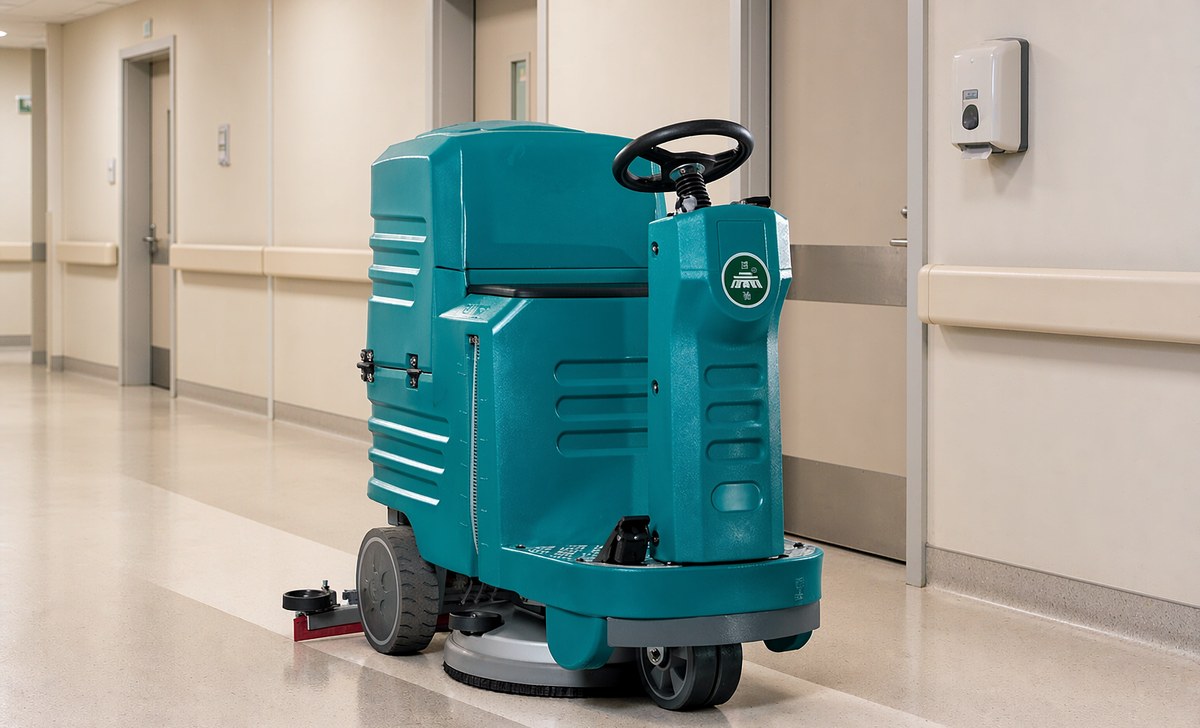
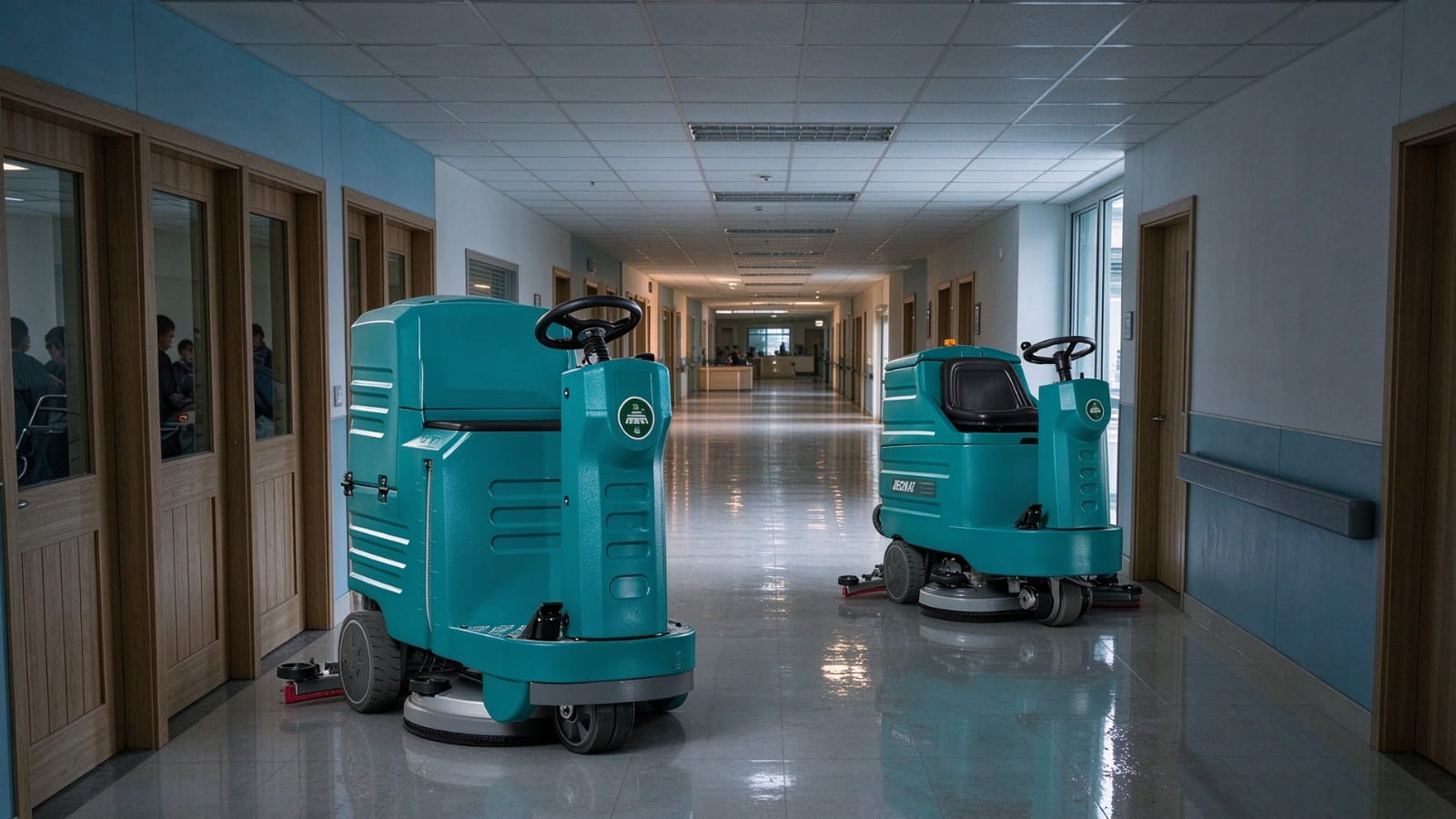
Ward corridors are the natural home for a compact ride-on machine; nothing else covers that much floor before the breakfast trolleys appear. A machine like the JIECHI A5 65 L mini ride-on floor scrubber is 62 cm wide with a 530 mm cleaning deck and a 770 mm suction path, so it fits a standard ward doorway and leaves the floor dry behind it, which is what matters when a patient could be walking there within the hour.
| Workflow | Window | Method |
|---|---|---|
| Theatre, between cases | 15–25 min | Manual, dedicated mop heads |
| Theatre, terminal | Night, after list | Machine, deck lifted, edges by hand |
| ICU and isolation rooms | Per policy, daily | Dedicated equipment, hand finish at edges |
| Ward corridors | 22:00–05:00 | Compact ride-on scrubber |
| Main atrium and public areas | 05:00–07:00 | Ride-on scrubber |
Two rules keep these windows workable. Finish wet work at least 30 minutes before a clinical area opens, and never park a machine in an escape route or a fire door recess overnight. Both findings undo a good cleaning record in one audit.
Five specifications decide whether a healthcare floor cleaning machine works in your building or fights it.
Cleaning and suction width. Cleaning width has to fit the narrowest doorway on the route with clearance to spare. Suction width should be wider than the cleaning deck, because the extra centimetres are what leave the floor dry. On the A5 that gap is 530 mm cleaning against 770 mm suction.
Turning radius and weight. Ward corridors turn tightly, and a heavy machine cannot go in a patient lift. At 220 kg the A5 is a realistic lift and corridor machine.
Water tank size against shift length. A 140 L machine will clean a main corridor run without a refill stop; a compact 65 L unit will not, which is fine if the route plan includes a fill point. Match the tank to the route, not to the brochure.
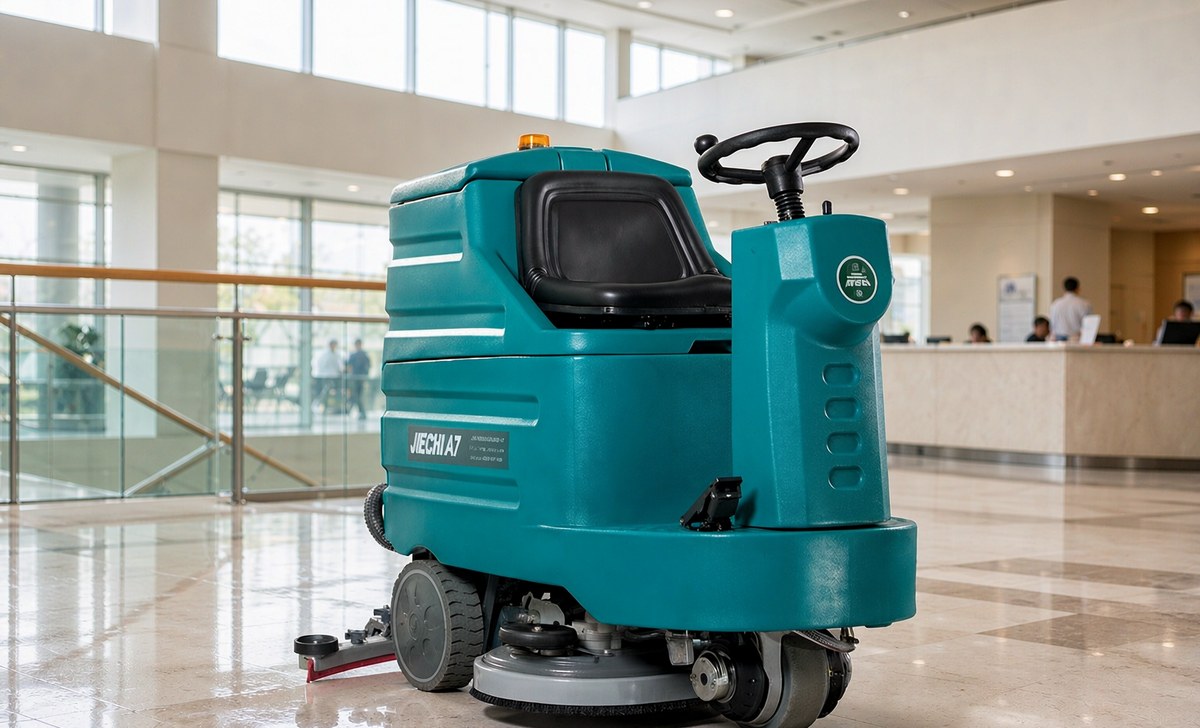
For main corridors, atria and canteen floors, step up. The JIECHI A7 medium dual-brush ride-on floor scrubber runs an 860 mm twin-brush deck with a 1,100 mm suction path and 140 L / 150 L tanks at 5,500 m²/h, which turns a hospital's public circulation into a two-hour job instead of a full shift.
Q1: Can a floor scrubber be used in an operating theatre?
A1: Between cases, most theatres stay on manual cleaning with dedicated mop heads, because the floor area is small and the time window is short. A ride-on or walk-behind scrubber is used for the terminal clean out of hours, with edges and corners finished by hand and verification swabs taken afterwards.
Q2: What noise level should a hospital floor scrubber be?
A2: Aim for 70 dB(A) or lower at one metre for equipment working near patient areas. Battery machines get you there; what undoes it is a worn or badly angled squeegee blade, which produces a squeal far more disruptive than the motor.
Q3: How often should hospital floors be cleaned?
A3: It depends on the tier. Critical areas are cleaned between cases and terminally after each list. Clinical areas are cleaned daily, with corridors done nightly. Public and support areas usually run on a daily routine plus a periodic deep clean, with entrance zones on a higher frequency than either.
Q4: Do you need a separate machine for isolation rooms?
A4: Dedicated equipment is best practice where the budget allows, because it removes the decontamination step from the critical path. If a machine has to be shared, the protocol has to include a full wipe-down of deck, squeegee and castors on exit, logged against the room.
Hospital floor cleaning works when the estate is tiered, the machines match the tier, and the result is verified instead of assumed. Get those three in place and the rest is scheduling.
Start with the zone map and the noise figure. Those two decisions set your equipment list, 按and your night window before a single machine is ordered.
Send us your corridor widths, floor areas, lift capacity and cleaning windows. We will recommend the right machine class for each tier of your estate.
Tel: +1 2403149021
Email: kliu@jiechi.com

留言
扫描至微信 :

 中文